Permanent Makeup
Ombre Brows Bristol: A Soft Front-to-Tail Gradient
From £330 · approx. 2 hr 15 min
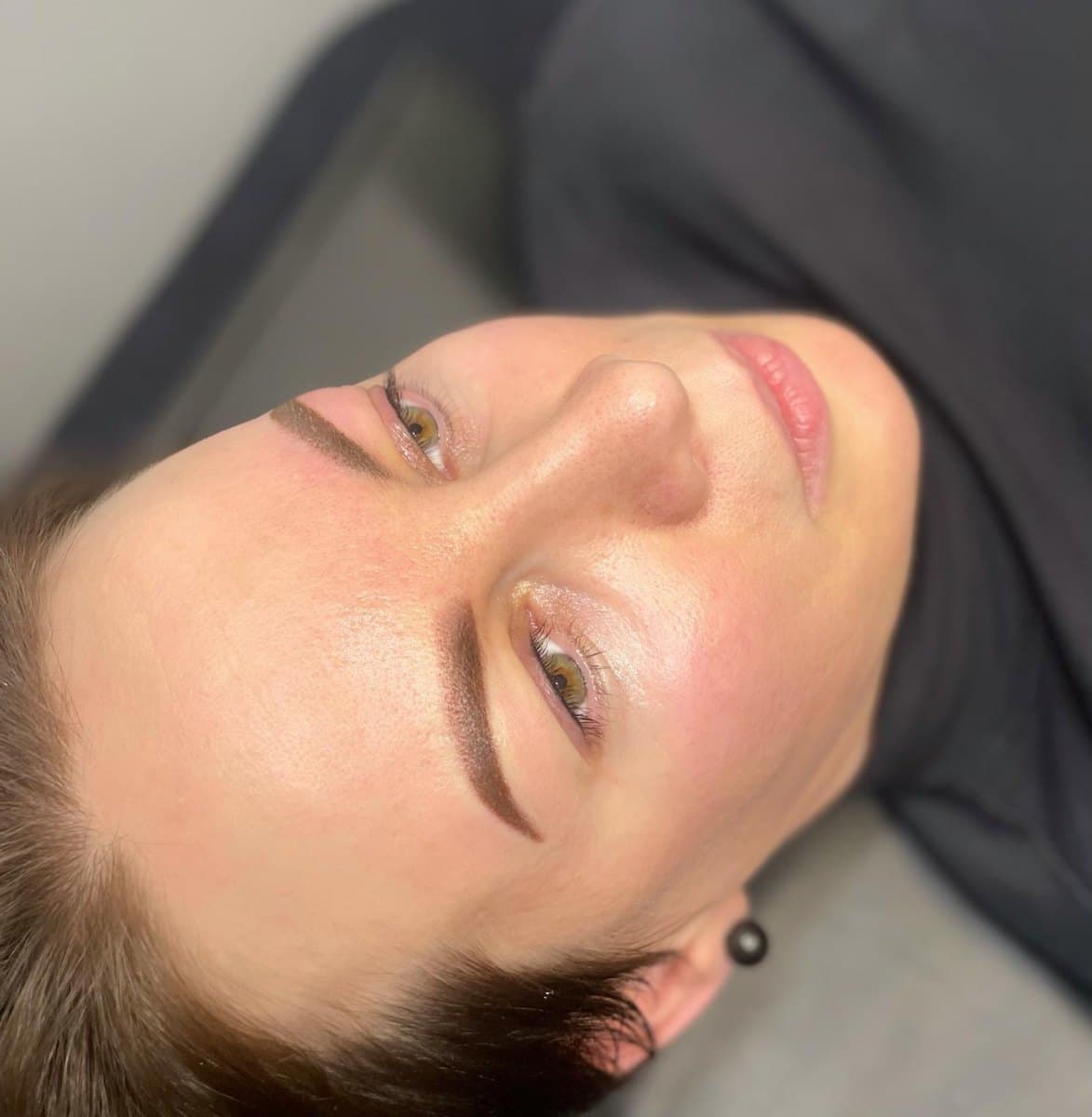
Ombre brows Bristol treatments use machine shading to create a softer front and a more defined tail. The £330 first-time appointment includes the perfecting session at 6 to 8 weeks.
If powder brows are a clean, evenly applied brow, ombre is the same brow with the front faded out. Closer to how natural eyebrows grow, where the bulb is always softer than the tail.
What an ombre brow actually looks like healed
The healed result has three distinct zones:
- The bulb / front 1cm. Soft, diffused colour, closer to a tint than a defined edge. Designed to read like brushed-through brow hairs rather than a painted-on line.
- The arch. The densest area of pigment. This is where the brow lift sits and where the eye-frame is built.
- The tail. Tapered colour that defines the outer corner of the eye. Slightly darker than the front but softer than the arch.
The visual effect is closest to what you'd get if a makeup artist softly diffused a brow pomade with a spoolie brush through the front and pressed harder through the arch and tail. The difference is that you wake up with that look every morning for 18–24 months.
Who ombre brows suit
Good for ombre:
- Soft, sparse fronts and denser tails (the most common natural pattern)
- You think powder looks "too much" but microblading looks "too natural"
- Combination-to-oily skin (the machine holds where microblading wouldn't)
- You like Korean-style, "no-makeup-makeup" finishes
- You've had powder brows and want a softer front next time
Less suited:
- You want a defined, uniform front (book powder brows)
- Very pale brows on pale skin where a soft gradient can look undertinted (powder brows give more visible definition)
- Extremely sparse brows with very little hair for the gradient to integrate with (powder brows often work better here)
A real client case study
A recent client came in with combination skin, dark blonde hair, sparse fronts from over-plucking, and dense tails. She'd booked microblading after seeing a friend's. At consultation, Nata explained that strokes through her oily T-zone would blur within six months, so she asked: what should you get instead?
Ombre was the answer. The soft, sparse front needed a gradient rather than competing strokes. The dense tail worked better with shading than overfilling. Her combination skin suited a machine. She wanted a cohesive shape, not maximized hair-stroke effect.
Her healed result at the perfecting session (8 weeks) showed the designed gradient: soft front, defined arch and tail, reading as naturally shaped. She returned at 20 months for a colour boost.
How an ombre brows appointment runs
Mapping: 25 minutes. Shape drawn on with washable pencil. Front bulb is sketched softer than the arch and tail. The gradient is mapped before pigment is applied. You sit up, check the mirror, adjust until you sign off.
Numbing: 20 minutes. Topical applied. A second pass mid-session.
Front pass: 15 minutes. Light density only to establish the soft front. Skipping this for an even initial pass is the most common mistake; it removes the gradient.
Arch and tail: 35 minutes. Density is layered through the arch and tail.
Blending: 15 minutes. A diffuse pass across the front-to-arch boundary to soften any step.
Aftercare: 5 minutes. Written instructions and balm.
Healing
Healing mirrors powder brows: days 1–3 the gradient looks more pronounced than it will heal, days 4–10 a fine crust flakes off, days 10–21 a "ghosting" window where colour looks uneven, days 21–42 colour returns into the designed gradient. The perfecting session at weeks 6–8 is when soft-front zones that didn't retain are touched in and the gradient is fine-tuned.
Pricing
£330 first-time including the 6–8 week perfecting session. £150 colour boost for existing Nata Beauty clients. The perfecting session matters for ombre because the soft front is where you'll need the second pass. Pricing that excludes it is misleading and usually costs more once the top-up is added.
Nata trained in eyebrow pigmentation at Lavinia F. Pop Academy (2020) and completed accreditation in permanent makeup and aesthetic dermopigmentation from Permanent Master, Riga (160 hours, 2017). She's registered with Bristol City Council for semi-permanent skin colouring (Reg. GSA/105599).
Nata Beauty is rated 5.0★ on both Google and Treatwell. The studio is at 10 Chandos Road in Redland, five minutes from Whiteladies Road and walking distance from Clifton, Cotham, and Westbury Park.
How to decide between the brow PMU techniques
The fastest decision tree, from this page:
- I want an even, defined makeup-look brow → Powder Brows
- I want a softer front and a defined tail → You're on the right page
- I searched for combo brows, or want the most natural finish → Combo Brows (the same machine-shaded brow as this page)
- I was looking for microblading or hair strokes → why we recommend machine-shaded brows instead
- I'm not sure yet → compare the brow techniques or book a free consultation
Book or come in for a consultation
The studio is at 10 Chandos Road, Redland, Bristol BS6 6PE, a short walk from Whiteladies Road and easy from Clifton, Cotham, Bishopston, Westbury Park, or the top of Gloucester Road. Budget two hours.
Book a free consultation to see the gradient sketched on your face in washable pencil before you commit, or read about PMU services.
Gallery
Frequently asked
Both use a digital machine to deposit pigment as a soft shade. Powder brows are deliberately even from front to tail: a uniform makeup-look brow. Ombre brows are deliberately graduated, lighter and softer through the front (the bulb of the brow), fuller through the arch, defined through the tail. Powder is uniform; ombre is gradient. Same technique, different shape philosophy.